
Chi-Square CalculatorPerform chi-square test of independence with contingency tables of any size.

Chi-Square Calculator
Perform chi-square test of independence with contingency tables of any size.
Set Table Size
Choose the number of rows and columns for your contingency table.
Enter Frequencies
Input observed frequency counts in each cell.
View Results
See χ² statistic, degrees of freedom, p-value, and significance.
What Is Chi-Square Calculator?
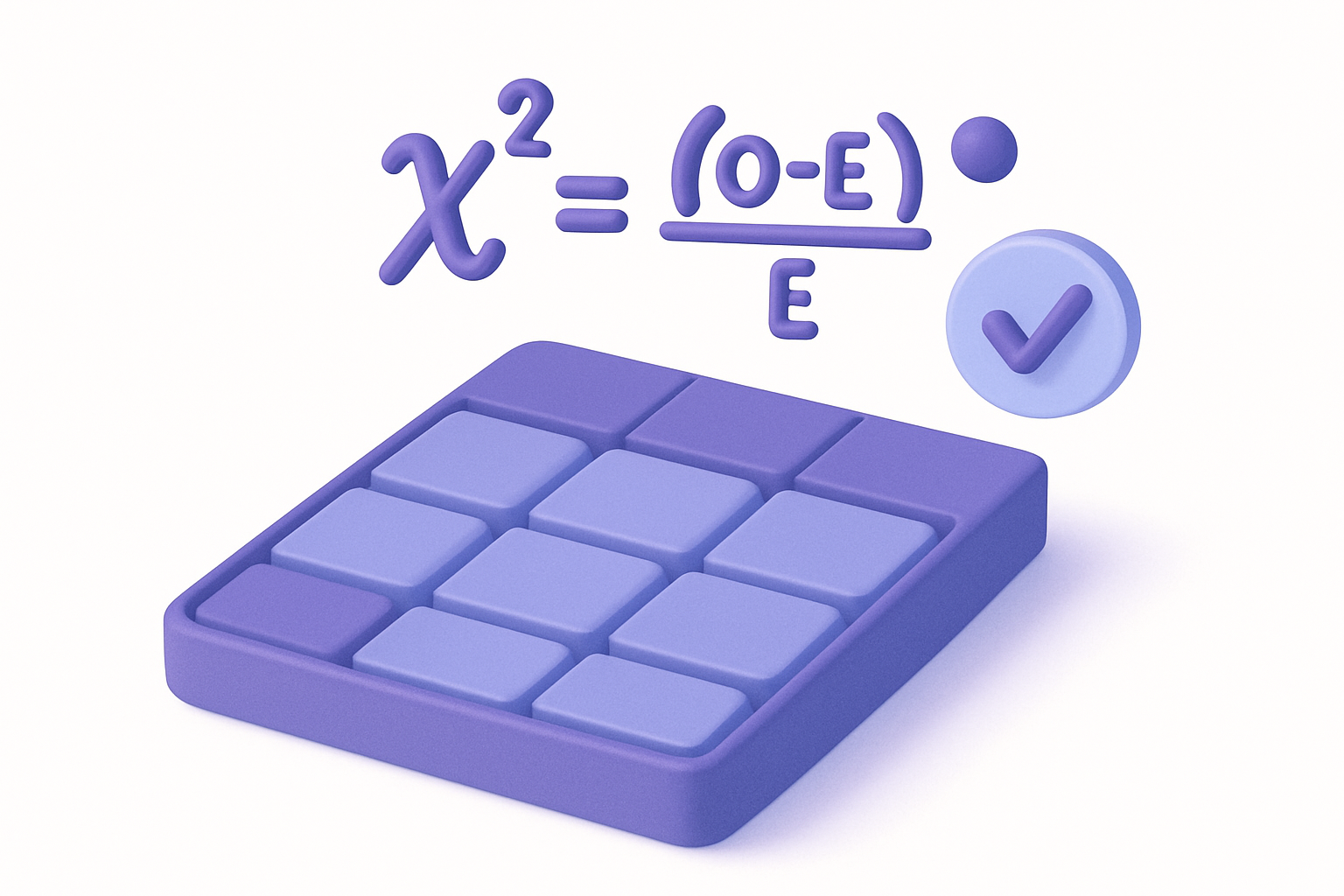
The Chi-Square Calculator performs Pearson's chi-square test of independence on a contingency table. Enter observed frequency counts into a matrix of any size (2×2 to 10×10), and the calculator computes the chi-square statistic, degrees of freedom, p-value, and whether the result is statistically significant at your chosen α level. The test determines whether there is a statistically significant association between two categorical variables. It is one of the most widely used non-parametric statistical tests in research.
Why Use Our Chi-Square Calculator?
- Flexible contingency table size (2×2 to 10×10)
- Complete output: χ² statistic, df, p-value, significance
- Adjustable significance level (α)
- Shows the chi-square formula for educational reference
Common Use Cases
Medical Research
Test association between treatments and outcomes.
Market Research
Determine if preferences differ between demographic groups.
Biology
Test genetic ratios against expected Mendelian proportions.
Social Science
Analyze relationships between categorical survey variables.
Technical Guide
The chi-square statistic is: χ² = Σ (Oᵢ − Eᵢ)² / Eᵢ, where Oᵢ is observed and Eᵢ is expected frequency. Expected frequencies: Eᵢⱼ = (Row Total × Column Total) / Grand Total. Degrees of freedom: df = (rows − 1) × (columns − 1). The p-value is calculated using the Wilson-Hilferty approximation to the chi-square CDF. Assumptions: all expected frequencies should be ≥ 5 (Cochran's rule). For 2×2 tables with small expected counts, Fisher's exact test is preferred. The test determines whether observed frequencies differ significantly from expected frequencies under the assumption of independence.
Tips & Best Practices
- 1All expected frequencies should be ≥ 5 for reliable results
- 2For 2×2 tables with small counts, consider Fisher's exact test instead
- 3The chi-square test only detects association, not causation
- 4Larger tables (more cells) need more data for reliable results
- 5Chi-square value increases with both effect size and sample size
Related Tools


P-Value Calculator
Calculate p-values from Z or t test statistics with one-tailed and two-tailed options.
 Math & Calculators

Z-Score Calculator
Calculate Z-scores and percentiles, or find values from Z-scores using the standard normal distribution.
Math & Calculators

Confidence Interval Calculator
Calculate confidence intervals from summary statistics or raw data with multiple confidence levels.
Math & Calculators

Correlation Calculator
Calculate Pearson and Spearman correlation coefficients with R-squared interpretation.
Math & Calculators

Percentage Calculator
Calculate percentages, percentage change, and what percent one number is of another.
Math & Calculators

Fraction Calculator
Add, subtract, multiply, and divide fractions with automatic simplification.
Math & CalculatorsFrequently Asked Questions
QWhat does the chi-square test tell us?
QWhat are degrees of freedom?
QWhat if expected frequencies are less than 5?
QCan I use percentages instead of counts?
QHow large does my sample need to be?
About Chi-Square Calculator
Chi-Square Calculator is a free online tool from FreeToolkit.ai. All processing happens directly in your browser — your data never leaves your device. No registration required. No ads. Just fast, reliable tools.