
Ohm's Law CalculatorCalculate voltage, current, resistance, or power using Ohm's Law and the power equation.


Ohm's Law Calculator
Calculate voltage, current, resistance, or power using Ohm's Law and the power equation.
Choose What to Solve
Select which value to calculate: voltage, current, resistance, or power.
Enter Known Values
Input any two of the remaining three values.
View Results
See all four values calculated with appropriate unit prefixes.
What Is Ohm's Law Calculator?
The Ohm's Law Calculator solves for any of the four fundamental electrical quantities — voltage (V), current (I), resistance (R), and power (P) — given any two known values. It combines Ohm's Law (V = I × R) with the power equation (P = V × I) to provide a complete set of results. The calculator automatically handles unit prefixes (mA, kΩ, MW, etc.) for easy reading. This is an essential tool for electrical engineers, electronics hobbyists, and students working with circuits.
Why Use Our Ohm's Law Calculator?
- Solves for any of 4 values: voltage, current, resistance, power
- Combines Ohm's Law and power equations in one calculator
- Automatic unit prefix formatting (mA, kΩ, MW, etc.)
- Accepts any two inputs to calculate the remaining values
Common Use Cases
Circuit Design
Calculate component values for electronic circuit design.
Electrical Safety
Determine current flow and power dissipation in circuits.
Education
Solve Ohm's Law problems for physics and engineering courses.
Troubleshooting
Verify expected values when diagnosing electrical issues.
Technical Guide
Ohm's Law: V = I × R. Power equations: P = V × I = I²R = V²/R. From any two known quantities, all four can be derived. Solving for each: V = IR, V = P/I, V = √(PR). I = V/R, I = P/V, I = √(P/R). R = V/I, R = V²/P, R = P/I². P = VI, P = I²R, P = V²/R. The calculator accepts inputs in base units (V, A, Ω, W) and displays results with appropriate SI prefixes: micro (μ), milli (m), kilo (k), mega (M). Ohm's Law applies to resistive (ohmic) circuits; reactive components (capacitors, inductors) require complex impedance calculations.
Tips & Best Practices
- 1Always double-check units — mixing mA with V gives results in kΩ, not Ω
- 2Power dissipation in resistors determines required wattage rating
- 3Ohm's Law applies to DC circuits; AC circuits need impedance calculations
- 4In series circuits, current is the same; in parallel, voltage is the same
Related Tools


Resistor Color Code Calculator
Decode resistor values from color bands with visual selector for 4-band and 5-band resistors.
 Math & Calculators
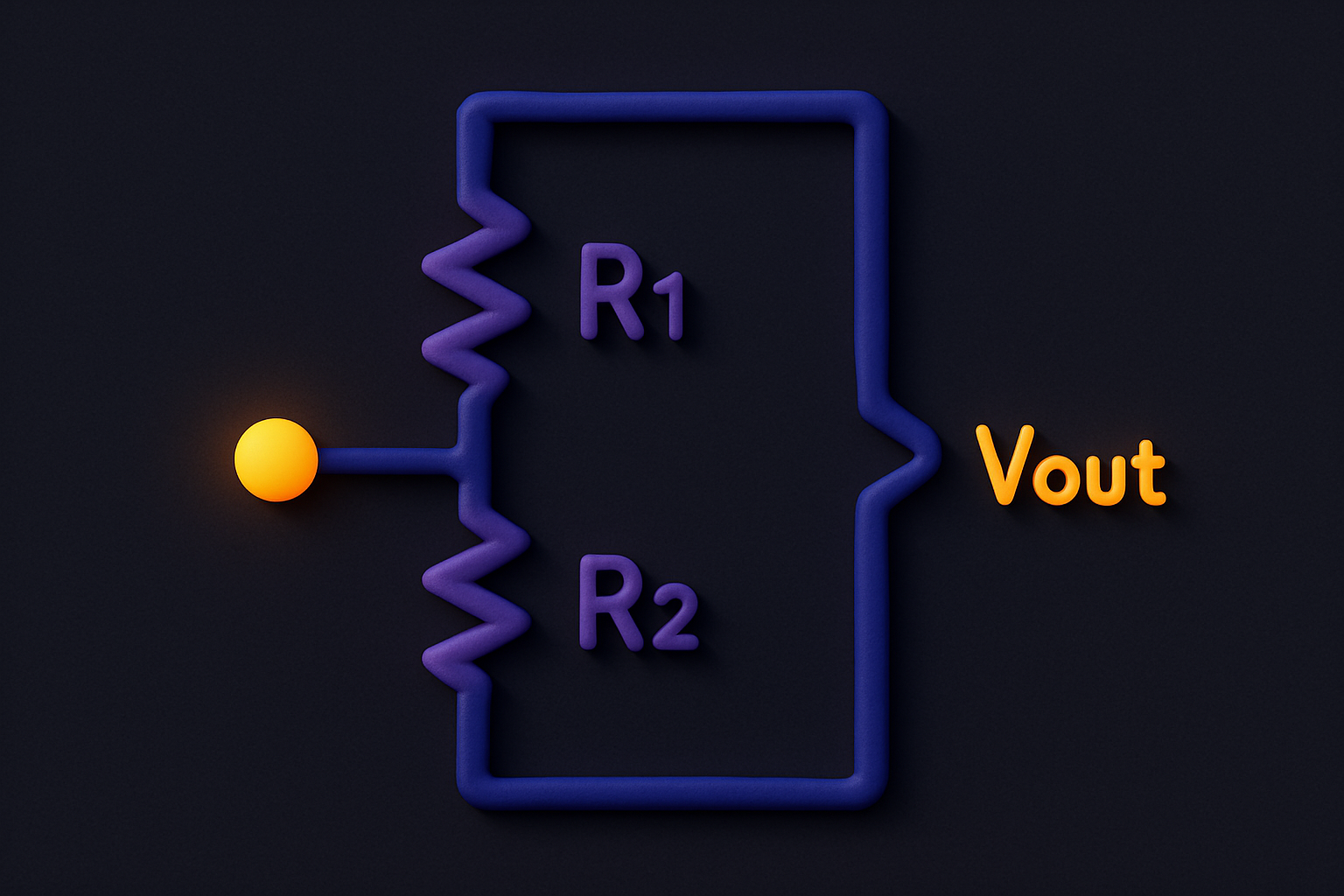
Voltage Divider Calculator
Calculate output voltage or required resistor value for voltage divider circuits.
Math & Calculators

Power Calculator (Electrical)
Calculate electrical power, voltage, current, or resistance using power equations.
Math & Calculators

Bandwidth Calculator
Convert between bandwidth and data rate units — bps, Kbps, Mbps, Gbps, MB/s, and more.
Math & Calculators

Percentage Calculator
Calculate percentages, percentage change, and what percent one number is of another.
Math & Calculators

Fraction Calculator
Add, subtract, multiply, and divide fractions with automatic simplification.
Math & CalculatorsFrequently Asked Questions
QWhat is Ohm's Law?
QDoes Ohm's Law apply to all components?
QWhat units should I use?
QHow do I calculate power?
QWhat is the relationship between V, I, R, and P?
About Ohm's Law Calculator
Ohm's Law Calculator is a free online tool from FreeToolkit.ai. All processing happens directly in your browser — your data never leaves your device. No registration required. No ads. Just fast, reliable tools.